
Good Thing They Don't Know Math
The scene: a father trying to get his toddler son to go upstairs to start bedtime routine.


Breath of the Wild
The Legend of Zelda: The Breath of the Wild launched in 2017 along with the Nintendo Switch, and despite it not even being a pack-in bundle, sold at a 1:1 ratio with the Switch. The Switch was an innovation in the console gaming market, and Breath of the Wild was a similar innovation in open-world gaming. In fact, it won Game of the Year 2017. It was the first game I played that I would truly call open-world, and on the launch week of its sequel, Tears of the Kingdom, I wanted to write down a few of my thoughts.
- Open-World: Breath of the Wild deviated from the typical Zelda format, in that it gives you all the tools you need from more or less the start of the game. There's a "tutorial" portion where you learn the basics and acquire the tools, but from then on, you're allowed to go where you want and do what you want. This is what makes Breath of the Wild so special -- player agency is the core of the game. If you want to go straight to Hyrule Castle and free the kingdom from Calamity Ganon with nothing but shorts and a tree branch, there's nothing stopping you from doing so. What it gets so right is that it presents you with a myriad of problems, but how you solve them is up to you. There is no wrong answer when it comes to playing this game. If you need to stay warm in the mountains, you can: cook a bunch of chili peppers and ingest them for temporary cold resistance OR just cook a bunch of food to restore your health every time you take cold damage OR make some money so that you can purchase a cold-resistant tunic, OR make a fireplace and carry a torch around you to stay warm OR a bunch of things I haven't thought of!
- Discovery: The first time I realized the weather played a role in this game, I died from the freezing climate of the mountains. I had to find enemy campfires and take them over to stay warm. Then I discovered that I could light my weapons on fire and travel with them to stay warm -- but then the weapons broke and I was out in the cold again. From there, I had to learn how to cut down trees, start my own campfires and use durable torches to stay warm, not tree branches. I arrived at this solution on my own, and it was a story unique to me. I was given the agency and the tools to discover on my own, and that's what Breath of the Wild does so well.
- This sense of discovery is ingrained into the DNA of the game. 100+ hours in, I'm still discovering new tidbits in the game. Follow your curiosity and the game will reward you. Nowhere is this greater than with the Korok Seeds, of which there are 900 scattered throughout the kingdom. I'm writing this article with over 400 in my belt, and I look forward to the time when I can get more. Link wakes up in the middle of the kingdom in a special place called The Shrine of Resurrection. It's a teleport spot, and on one of my many teleports there, I decided to look back at the place that I woke up from, and there were special lights there. When I examined the lights, it was a Korok seed waiting for me, a little nugget of the game rewarding my curiosity.
- History: The main character, Link wakes up from a 100-year slumber at the start of the game. 100 years ago, a blight fell on the kingdom and ravaged it, the Calamity Ganon. Nobody could stand against it, including Link. He wakes up with no memories of how he got there, who he is, or what he's doing. That's exactly where the player is at when you begin. I love this mechanic: both you and Link are starting at ground zero. The kingdom becomes a character itself, as the Princess Zelda has left you 12 pictures from different areas of the kingdom, for you to recover your memories. You have to explore the kingdom and find just where these pictures were taken from, in order to unlock your memory. Each memory is special and the feeling of finding another piece of yourself is so rewarding.
So many times I found myself moving my personal goalposts for the game, that special marker that I could consider it "finished" and move on to the sequel, sure to be another hit. My first goalpost was to free the 4 divine beasts of the Kingdom, recover all 12 of my memories and then defeat Calamity Ganon. Then I discovered that there's a 13th memory you unlock, allowing you access to the "true" ending of the game. Then I wanted to make sure that I could leave the hero in a comfortable position, so I went on a massive Korok Seed quest. I'm at 400+ now, but may call it, after completing my current goalpost: Tarrey Town.
"From the Ground Up" is a side quest in the video game that involves you helping to create a new settlement called Tarrey Town in the Eastern part of Kingdom. It's a winding quest that takes you across the 4 corners of the kingdom, and, in my opinion, it's a metaphor for post-racial society. Initially I learned about this sidequest when I was binging the game soundtrack, which has over 200 tracks and is amazing. The Tarrey Town theme is no different, as it iterates on itself. It starts with a quaint, peaceful theme anchored by a saxophone. As you add more people from around the kingdom, notes and themes from their villages of origin are introduced into the song. The lumbering, boisterous trumpet represents the burly Gorons who come to help mine the town. The graceful flute enters the theme as the skyfaring Rito set up shop and trade in the town.
It's a beautiful cornucopia of different people with different skillsets and a celebration of diversity. Everybody contributes their own skillset and everybody is celebrated, much like in the song. I helped make it happen; I helped create this harmonious community comprised of all sorts of people, and better than vanquishing a monster, better than finding the strongest sword, that's the greatest gift that this game could give me. Healing a kingdom in the face of calamity and trauma. I couldn't have imagined a better way to close out my time here. Goodbye for now, Breath of the Wild. Thank you for two months of joy.
Nope (2022)
Screencaps from fancaps.net
I have kids now and it's not so easy to do this regularly anymore. But still I try, and I'm really happy with the last movie I borrowed. I already knew I liked the team of Get Out (2017), so I knew I was going to try Nope (2022). I didn't expect to like it this much, and honestly there's so much content in the world that it's hard to slow down to talk about one thing, before moving on to the next. I'm purposely slowing down so I can talk about it.
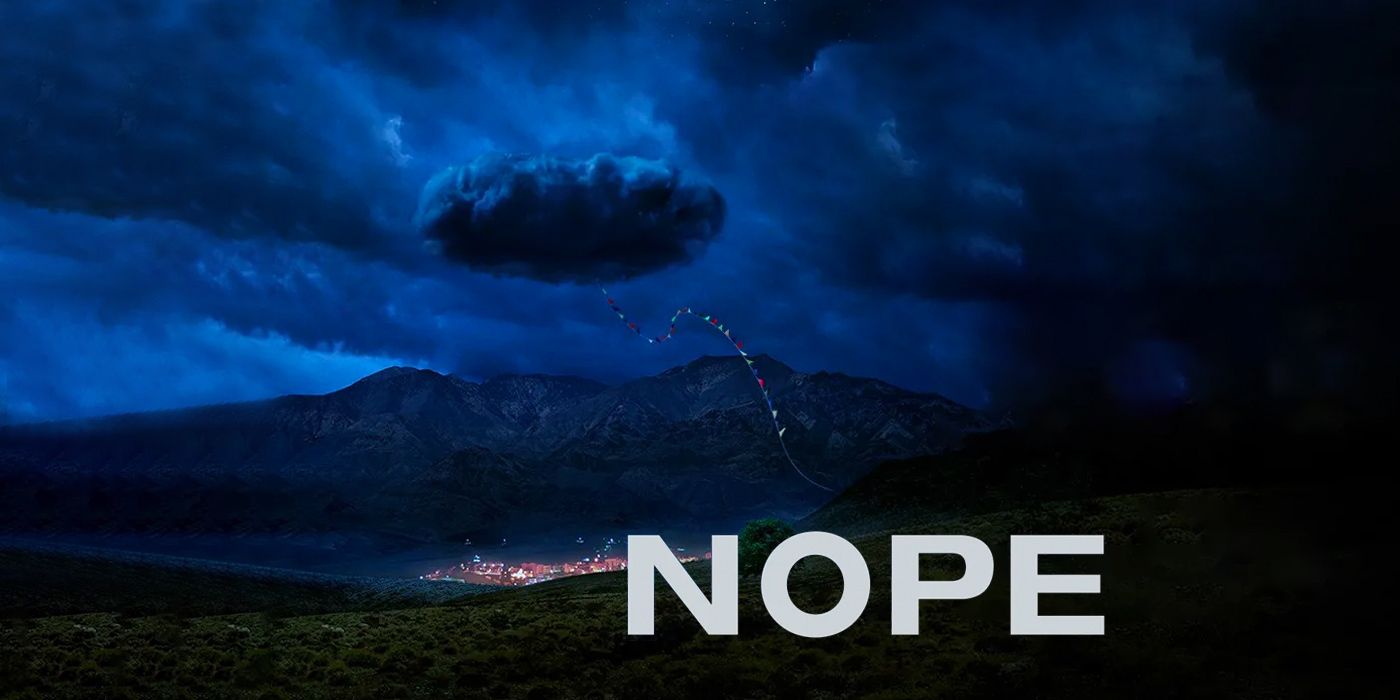
The last time I felt this way about a movie, was probably Prey (2022) or Arrival. And if I really wanted to go back in time, The Fly. There's really a lot that the story is addressing, and it's up to you what you want to tackle. I really like Nope (2022) and if you like any of those other movies that I mentioned, you might like it too.
Spoilers follow for the rest of this post. If you think you'll like it, you will. So just go watch it and come back. You'll thank me later.
=================Last Warning=================
Nope is a Neo-Western sci-fi horror film, and I'm so happy that I got to type those words out. It really sneaks up on you, and 30 minutes into the movie I was still wondering just what exactly I was getting myself into.
- What makes it a Neo-Western? It's about one poor family that's down on their luck, and their need to dig and strike gold. It's told in modern times so it's about their attempt to go viral and cash in on the mysterious UFO (UAP?) in their neighborhood before everyone else finds out.
- What makes it sci-fi? There's a UFO.
- What makes it horror? The mysterious UFO is more than it seems.

The movie starts with Otis Senior, a horse rancher and his son talking about their horses. Abruptly, a shower of debris falls from the sky and a falling quarter kills Otis Sr. His son, Otis Jr holds on to the quarter and we pick up 6 months later. Otis Sr and Otis Jr are the descendants of the Haywoods, the name of the jockey that appeared in the very first motion picture, Plate 626 from Animal Locomotion. In reality, this jockey was never actually credited, so we'll never know his name, but most jockeys at the time were Black, so this is a small creative liberty taken to highlight the truth of the exclusion of black contribution to American entertainment. It doesn't make things better that the UFO harasses the one black-owned farm in town either, but that's the movie. If you ask me, the primary theme of the film is not race, but rather spectacle, and they tell it to you upfront with the opening quote from the Bible:
“I will cast abominable filth upon you, make you vile, and make you a spectacle” (Nahum 3:6)
The rest of the film is given to you as a way to make sense of that quote. The character of Jupe is a great example. He was a child actor on a 90s sitcom that employed trained chimpanzees as actors. There was a horrific incident one episode where a balloon popped and the chimpanzee went ballistic on the entire cast. Only Jupe survived the incident unscathed, with the others either killed or seriously mauled. However Jupe internalizes it, he's turned it into a business of sorts -- he holds the sitcom memorabilia in a secret room in his office and sells admission to it in his amusement park, "Jupiter's Claim," a Western-themed park. The show exploited an animal for spectacle, and the animal went awry. Since then, it has a devoted fanbase of people who will pay just to see that secret room, and now it's Jupe who's exploiting that spectacle. People just can't take their eyes away.

Because he survived the incident with Gordy, or despite it, he attempts to monetize the UFO. He turns it into a show in his amusement park, and as if to scoff at him, the UFO arrives earlier than he anticipated and shows him what it thinks. It consumes him and the entire audience. For misinterpreting their relationship, Jupe was punished. He misunderstood the animal and didn't give it the respect it deserved. This is in direct contrast to OJ, who quietly observes the UFO, keeps his distance and respects its rules of engagement. Like you don't look a horse in the eye, you don't look this thing in the eye. You can't engage it as a spectacle.
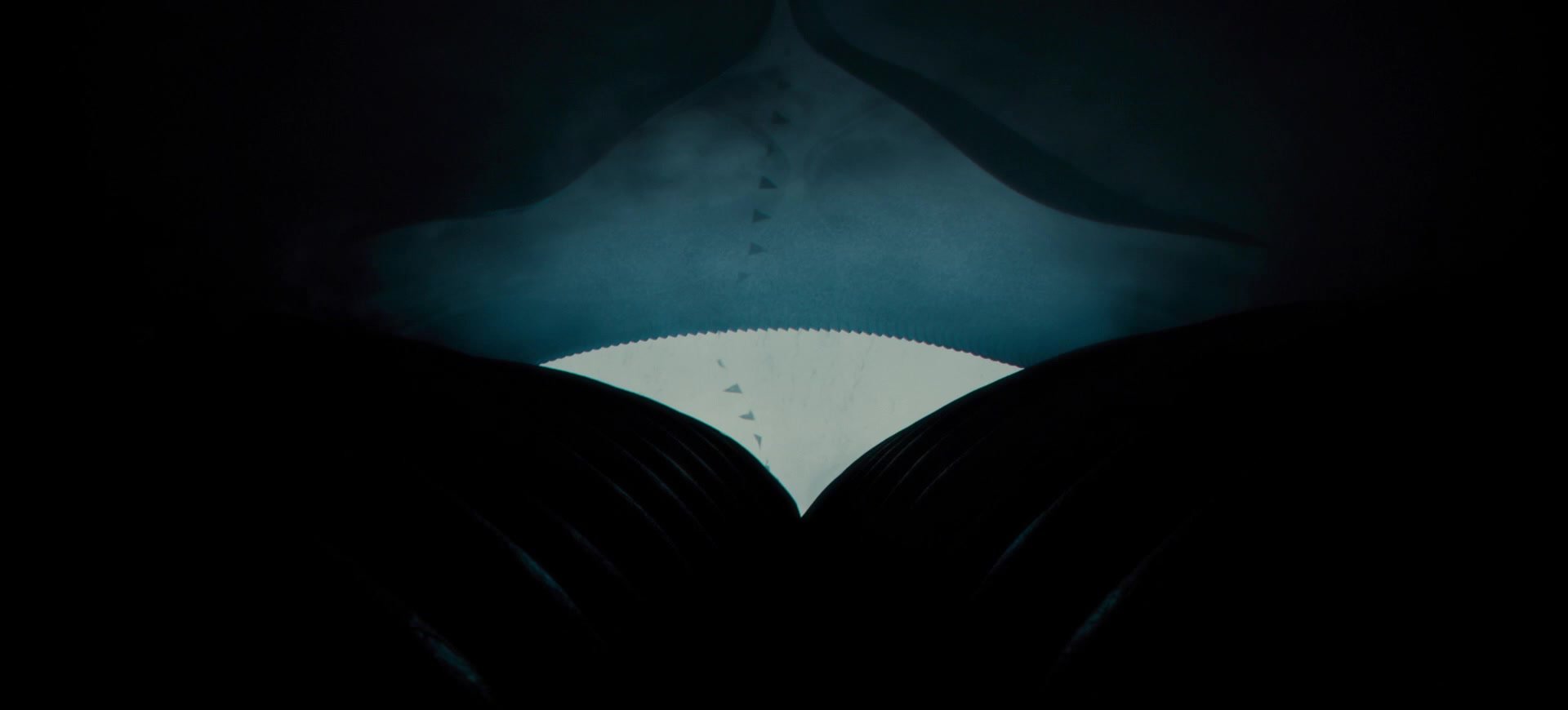
I love these amorphous shots of what you later find out to be the innards of the UFO. Initially, all you see is darkness, with corridors of light and unsettling sounds of pulsating, and later screaming. Most of all, the horror is the unknown. These shots were worth every second.
The Jupiter's Claim incident goes on the news and it becomes more urgent for OJ and his sister to film the UFO and, in a sense, avenge their father, before other people come to town to try to capture the UFO. They set up an elaborate plan with a Geek Squad UFO enthusiast and a filmmaker auteur.
They use what they know about the UFO -- the fact that it interferes with electromagnetic waves in its area, the fact that it gets indigestion from a specific thing, and they set a hilarious stage for the beast.

They save all the action for here, and it's great. It becomes a man vs. animal scene where the only thing man is trying to do, is survive and get the animal on non-electronic film.
There's a mood to the movie, an atmosphere that gives you this sense of dread. Initially, we don't really know what's going on with this giant UFO, only that it spooks the horses and sometimes you can hear screaming when it's nearby. The movie works really well at this feeling of suspense, climaxing in this amazing scene at an attempt to capture the UFO on film. The UFO reveals its true form, and I love the design here.


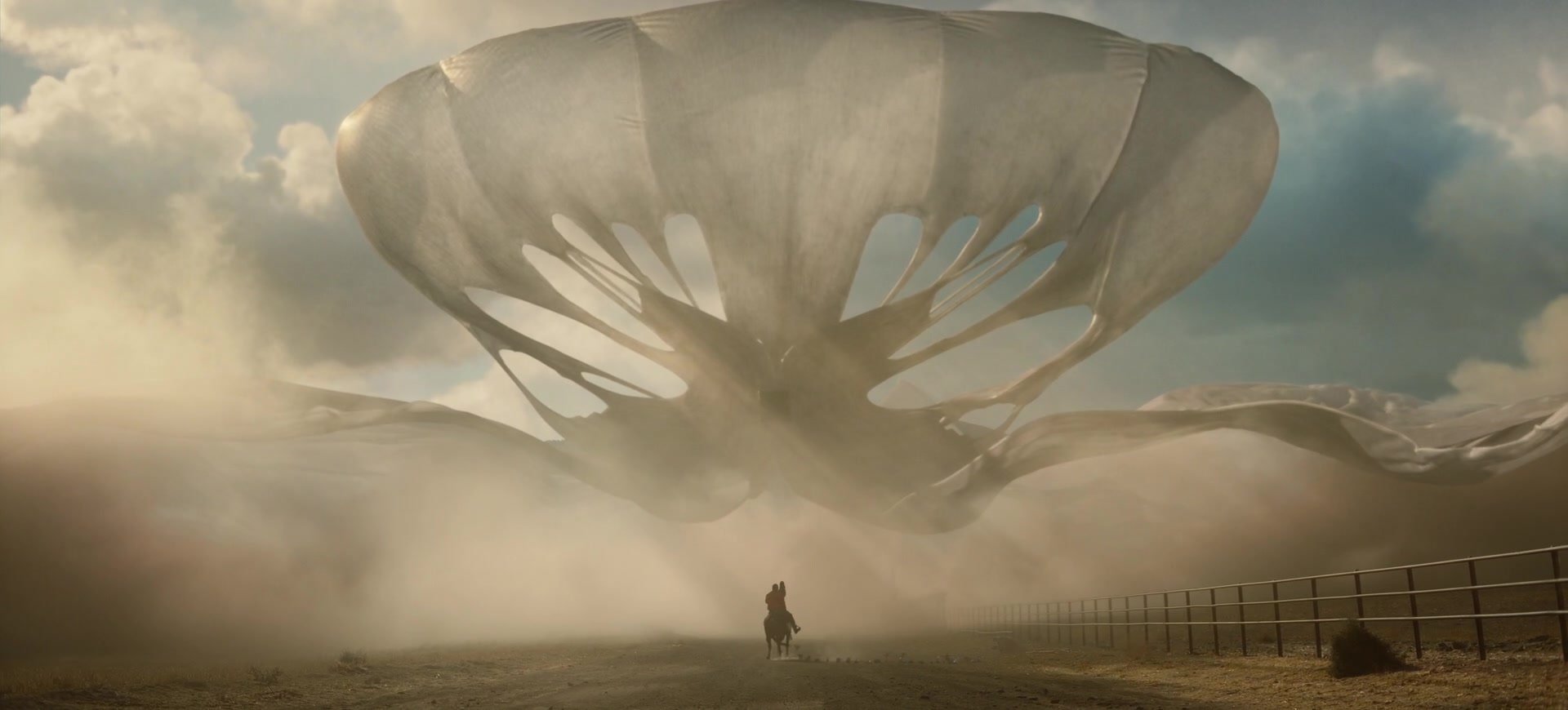

OJ buys enough time for his sister to get a "final shot," and the film is realized with this final shot: OJ the lone man riding on his horse, still standing as the dust settles.

It's a great shot. It's a victorious shot, and it's a Western shot. He survived and now this time he gets to be the one to tell the story. He and his sister are the ones with the unique footage and they get to reclaim the story that was taken from their ancestors.
Shang-Chi Volume 2 and Legion (FX) Season 2
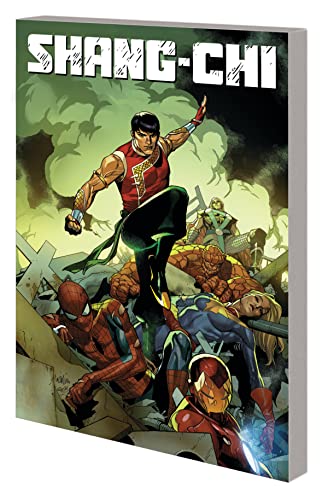
collects issues 1-6 of Shang-Chi (2021)
by Gene Luen Yang, Dike Ruan and more
Shang-Chi, Marvel's greatest fighter, was raised by his dad to take over the family business, a criminal empire. He finally did! But he wants to use the empire for good, and seeks to right the wrongs of the past as the Supreme Commander of the Five Weapons society.
In this volume, Shang-Chi tows the line between Supreme Commander and Avenger as he encounters a different avenger in each issue. He teams up with Spider-Man to investigate a drug/weapons ring originally instituted by Shang's father. He infiltrates the auction of a cosmic cube with the help of Captain America. Some of it seems pretty clear, and then others don't -- he breaks into the Baxter Building to get access to the Negative Zone and learn what a recurring dream means to him, and his brother steals the Cosmic Cube from under his eyes, forcing Shang to choose between truth, and family.


Directed by Noah Hawley, starring Dan Stevens, Rachel Keller, Aubrey Plaza and more
What's more terrifying...fear or the frightened?
I generally don't write about television series, because there's so much about the medium that you can't capture on the written word. It's much easier to write about comic books when you can point to a specific moment, word-bubbled and sound-effected. But I'm also at about that point in my life where I'm consuming more television than comic books -- at the end of the day, it's easier to veg out on a couch in the basement than grabbing ahold of a book/tablet.
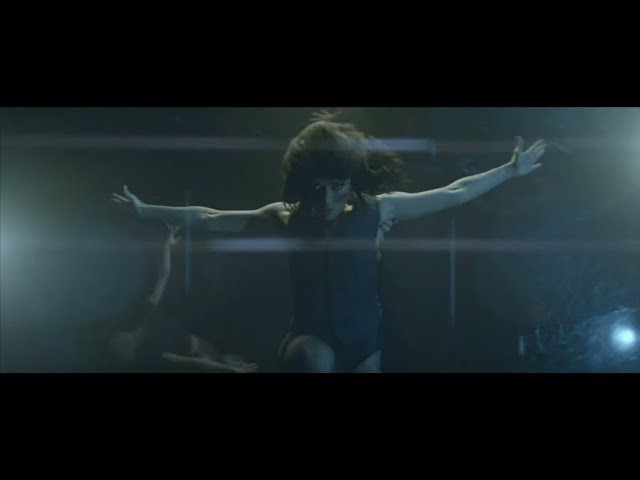
All that said, Legion is not the kind of TV series you should read about. It's TV you have to experience, and that carries over into Season 2. There are whole episodes dedicated to a single emotion -- and these are some of the strongest episodes. For example, there's an episode that gives us 3 alternate timelines that David Haller could have lived, all amounting to what his relationship with his sister means to him. Completely unneeded to the plot, but that was never the point. It's about a feeling, an experience. Season 2 is so brilliant at this. The opening episode is such a great way to start it off. There's a time skip, and a fog of distrust that keeps you from telling what's really real or not. As David stews in the sensory deprivation tank he remembers...telepathic dance-off:
If you must know, Season 2 was billed as a "race." With the Shadow King at large, he's poised to reclaim his original body and restore his full power. It's up to David and co, now working with the governmental shadow agency Division 3, to stop him. The season is told in three acts mainly:
- Find the body
- Who's that body?
- Stop the body
And no, I'm not going to elaborate :) Season 2 doesn't reach the highs of Season 1, where they spent a 3-episode arc on a single moment in time, and the S2 finale really doesn't stick the landing, but that doesn't discount the strength of the individual episodes. If I could edit out a portion of the S2 finale and call it a season, I would, but it's going to leave you with a lot to think about either way. While the season didn't need to be this long, the time that they spent on each episode was valuable and a testament to the creative strength of the show. Style just oozes out of every moment here.
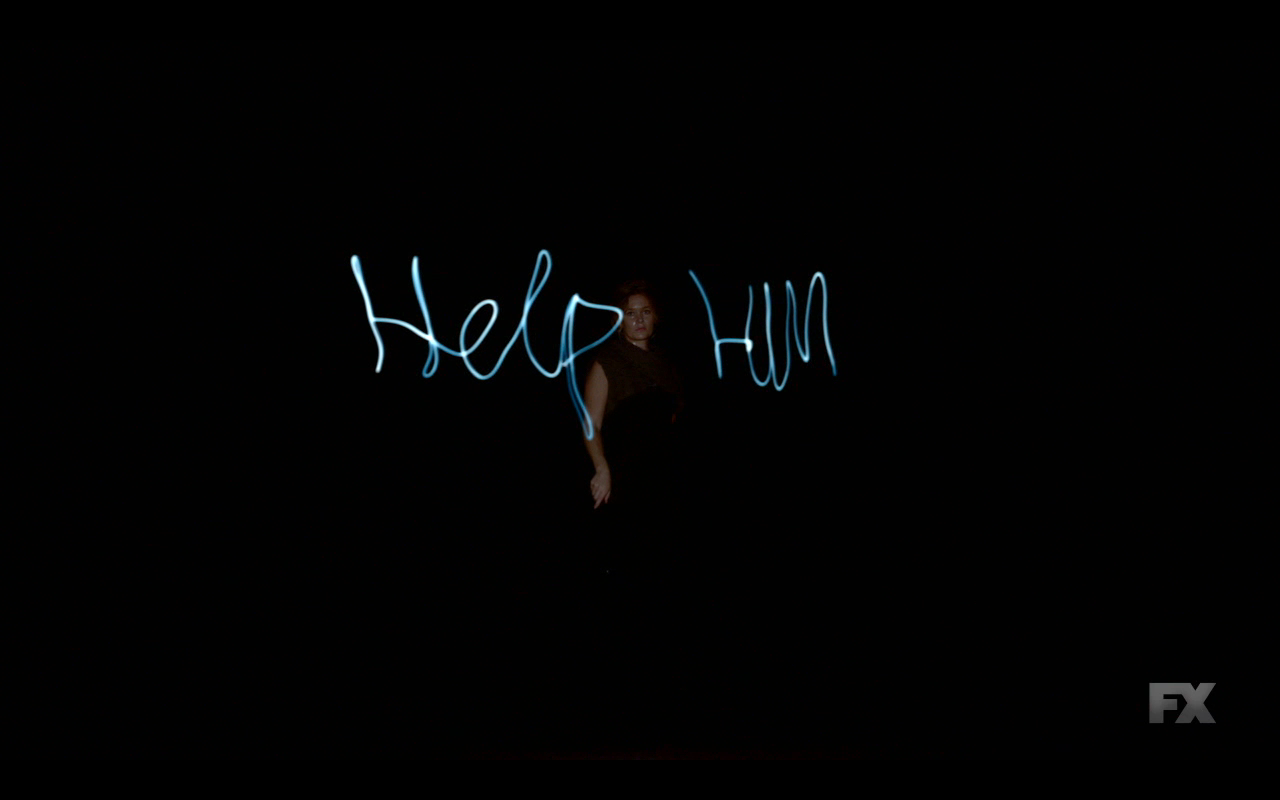
----------Spoilers follow. You've been warned.----------
- Why didn't David's schizophrenia manifest until...the final few episodes?
- Is David the villain, or the villainized? I really struggled with this after watching the season finale. I'm sure it's somewhere in between, but it's pretty obvious that Farouk had meddled with the group's minds -- he whispered a delusion into the rat which spread itself across the entire building. (Or was the delusion the truth?) By the time they were going to start Farouk's trial, it 180'd and became David's trial. This ties into the previously narrated "Ship of Fools" segment, where if all the apples are bruised, then it's the unbruised apple that is bad, the sane man who's crazy, David the only one not under Farouk's influence. It took me so long to find this, but the clip is here. Here's my other supporting argument that ties into the narrated sequences: when Shadow Melanie shows Sydney the "truth," David torturing Oliver, she's literally showing her pictures in a cave, directly tying into the allegory of the cave. While I don't think David is completely without fault, the season completely glosses over the influence of Farouk, who is clearly manipulating others for a certain outcome.
- I loved the mind maze as a two-episode set of character pieces. Sydney's portion in the second part could have been a whole indie movie by herself.
- David, the rapist? I think this was enough to turn off a lot of people from the show for good. I think what I really needed to get through this was to try to understand where David was coming from. He was in a hurt place and looked for help from the only person who loved him, now turned against him. By no means does it excuse what he did, but within context, it's possible to understand why he did it.
- I was really rooting for David and Syd -- their relationship was the heart of Season 1, but sometimes it just doesn't go that way.
- Lenny, played by Aubrey Plaza, was brilliant as the Shadow King. I get why they brought in a real person to play Farouk, but this is kind of the beginning of the end for Lenny.
- The Jon Hamm-narrated segments, plus the final one by Cary, were pretty out there, and eerily reminiscent of the political climate at the time. I only have kudos for the fact that they chose to devote screen time to this.
- The telepathic battles were endlessly creative, culminating in an animated scene similar to Community's foosball anime battle. It was dope.

Singles: Clear, We Have Demons, The All-Nighter, Snow Angels, Night of the Ghoul
What is this, pilot season? Anyways, I found out you get a bunch of "free" digital comics via an Amazon Prime membership, so I decided to give them a whirl and see what stuck. There's some big names on these "comiXology originals," so it seemed like a good way to get more of my favorite artists.


Clear #1
by Scott Snyder and Francis Manapul
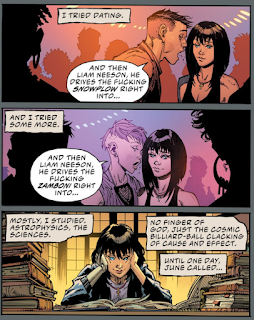
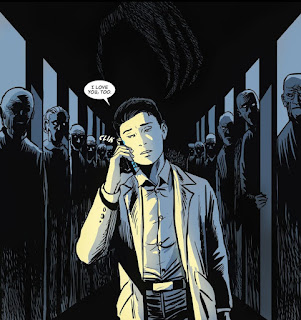
Snyder and Manapul create their version of a Surrogates-style dystopia -- only instead of everyone hiding away inside their robot bodies, everyone is hiding behind a "veil," a digital filter that virtually repaints the world around them. Want to live in the roaring 20's? Boom, now that hobo on the street is a swinging dancer. Prefer the future? Boom, the rats eating the garbage in the alley are cyberpunk raccoons now.
The main character Sam Dunes is this hardboiled P.I. kind of guy tracking down "black" veils, illegal filters being sold when he finds out that his ex-wife has been murdered. Unlike the rest of society, he still chooses to view the world with "clear" eyes without a veil, along with one of his clients, an obvious femme fatale character.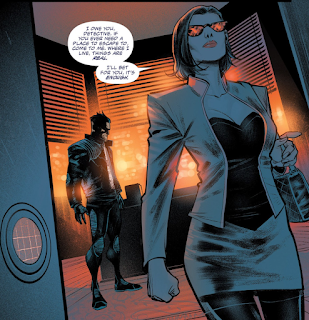

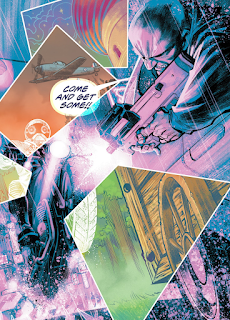
It's got the trappings of a decent neo-noir cyberpunk murder mystery. And honestly, I can't say no to Francis Manapul's art anyways. I wonder why Brian Buccellatto isn't on his colors anymore, but they're gorgeous all the same. Cool blues appear in the morgue, and the ending scene is encased in this beautiful sunset orange. Here's the highlight of the issue, when Sam is injected with a black veil meant to take him off the trail of the illegal dealers. He begins to hallucinate a whole set of weird veils while chasing them down.

We Have Demons #1
by Scott Snyder, Greg Capullo, and Jonathan Glapion
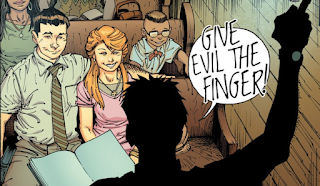
Man, Amazon can't get enough of Scott Snyder huh? We Have Demons centers around Lam, a snarky teenage girl from Florida: the issue is about her finding out that her pastor father is actually a demon hunter -- and when he dies, it's up to her to take over the family business.
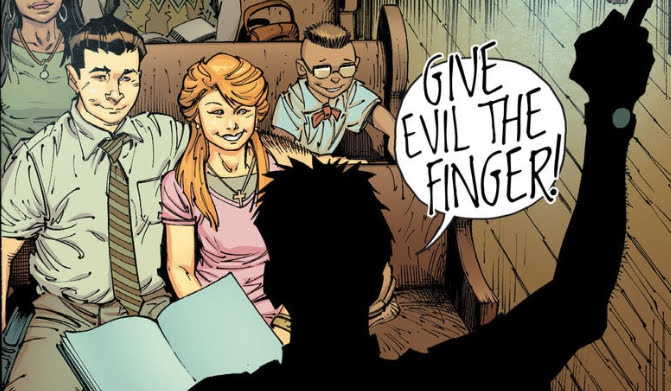
Think Buffy the Demon Slayer. The one thing that makes this series stand out is this whole creation myth story about the "halo" and the "horn." The lightest element in the universe, and the heaviest element in the universe, meant to somehow scientifically represent good and evil. If anything will give this series legs, it'll be how they flesh out this universe. And how many Liam Neeson jokes they can pull off.

Snow Angels #1
by Jeff Lemire and Jock
This single issue is about a girl's twelfth birthday on a hunting trip with her dad and sister. It's some kind of sci-fi snow world dystopia where they can only stay in the "trench," this seemingly endless trail of ice below the surface.
They come back from the hunting trip to find their whole village murdered by the "snowman," and that's pretty much the issue. It's clear this series was meant to be binged rather than read serially. If I have any feelings about it when I read the collection, I'll let you know.
Night of the Ghoul #1
by Scott Snyder and Francesco Francavilla
Now this is a #1 issue! Snyder really shows his range here and Francavilla is the perfect artist for this suspenseful horror comic. It's about a father and son who drive through the woods to this secret hospital nestled away in the dark. The father makes up a story to see one of the patients, this decrepit-looking old man to profess his love for a film that the man directed, originally lost in a studio fire, "Night of the Ghoul." At first the flesh-faced man denies it, until he realizes it's too late and has to let the father in on the truth.

All the while, we get these burnt-reel panels of the lost film playing in between the real-time scenes, finally ending in a climactic attack of the ghoul. The son makes a call to the mother, telling us that there's some things they're not letting us in on, and it's icing on top of a suspenseful, immersive cake of an issue. This is a horror comic done right.
The All-Nighter #1
by Chip Zdarsky and Jason Loo
Just your average everyday comic book super hero -- except this one's a vampire. That's pretty much it, with the added wrinkle that there's these things called "the takers," some kind of organization that will kill you if you ever reveal to humans your true nature.
The art itself is standard superhero fare.
Subscribe to:
Posts (Atom)

Stats a-go-go
