Showing posts with label batman. Show all posts

Batman Volume 10: Epilogue and Blanc (2023)

We here at chezkevin have always been a Batman comic book blog first, everything else second. So, today we conclude the 2011 "New 52" run of Batman and include a recent video game I finished.

Batman Volume 10: Epilogue
by Scott Snyder, Greg Capullo, James Tynion IV and more
collects BATMAN #51-52, BATMAN: FUTURES END #1, BATMAN ANNUAL #4 and a special preview of BATMAN: REBIRTH #1

These are mostly non-stories that wrap up the the series, putting a bow on the whole package. It's a collection of several standalone stories and tie-ins to other Batman events, much like Volume 6: Graveyard Shift.

  1. Remains: A Future's End tie-in, a heist story in which Batman risks his life for one last go, to steal a major component from Lexcorp for his clone machine (what clone machine? See Volume 9). There's some pithy dialogue from a hologram Lex as Bruce infiltrates the facility, and if it weren't for the cloning thing, would be a pretty good timeless Batstory.
  2. Madhouse: If it weren't for the whole losing-his-house thing, would be a pretty good timeless Batstory. In the aftermath of Superheavy, Bruce reclaims his Manor from the city, which somehow repurposed it to Arkham Asylum, but not before he has to kick out some of the inmates. It's a nice closed-door detective story that demonstrates how Batman is more than a suit: it's the man underneath. 

  3. Gotham Is: This is the "timeless" story you're looking for. This feels like a story that you could read at any point in the history of Batman. It's mainly centered around a journalist whose whole column is about how he takes reader suggestions for what "Gotham Is," a kind of collaboration between reader and writer about their shared city, in the midst of a city-wide blackout. Of course, Batman is on the case along with his extended family, and we visit a host of supervillains, including the Penguin, the inmates at the Asylum, and the Society of Owls underground, but they all admit that they weren't behind it. The twist is that it was just a freak natural occurrence that resolves by daybreak, giving us one last chance to tour the Gotham City of Snyder and Capullo. A solid slice-of-life Batstory.
  4. The List: A flashback story of Bruce's healing process as a child, into adulthood. He makes a checklist of things he needs to do in order to move on from his parents' death. It's a cutesy but very nice way to put a pin on the series: ending on issue #52 and checklist item #52: Remember that your parents will always be proud of you.
In the end, they did a great job of showing something new about Batman in an increasingly repetitive and derivative genre. They told us the whole time when they showed in the very first issue of Batman facing down another jailbreak of villains from Arkham Asylum, with a smile: Batman is hope. Batman is insanity. Batman is fighting a battle, knowing that it will never end, but knowing that the fighting itself is victory.

Blanc (2023)
by Gearbox Publishing, played on Nintendo Switch

I ran into this game last year and was easily taken by the charming, artsy style. It was recently on sale for $7.50, down from $14.99 and when my wife said she was willing to partake, it was a no-brainer for me.

We finished over the course of roughly 2 weeks in 30-minute play sessions, for about a total of 3 hours total playtime. It's quite a short game, but that might have been the only way we would have been able to digest it. Between putting the kids down for bed and various "me time" things, it wasn't always easy to get the two of us to sit down together and apply our brains at the end of the day.

As for the game itself: there are ten chapters, never really marked or called out during play. The screen itself is very minimal and there are no "HUD" aspects you'd expect in a "traditional" game, ie, a map a health bar, progress bar, and so on. This really emphasizes the background itself, and it's gorgeous. For some reason I have an affinity for black and white: our dog is black and white, our sheets are black and white, and the sheer visual imagery of the game is in black and white. I found myself taking screencaps every now and then; it was such a beautiful game.

The "game-y" aspects of it come in when your characters are able to do certain actions, ie, jog, slide down a snow-covered hill, jump to a certain terrain or help a character or call for help. Other specific puzzles come into play when you need to interact with other characters in the game: IE, providing a windshield from the snowstorm so that little ducklings can get to their mother duck. There are various NPCs in the game, and it's a little heartbreaking how some of them conclude (spoiler: the ducklings AND the baby goats get pissed at you after they miss a jump and that's just the end of your relationships!)

The mechanics are not always smooth. Sometimes you have to be in just the right position to get the right prompt, and there was a variety of puzzles that were difficult not because they were a puzzle, but because the mechanics of the game just prevented you from seeing the puzzle itself. This is the largest failure of the game, buttressed by just utterly gorgeous hand-drawn views.

Blanc isn't a perfect game, but it doesn't need to be. I got my money's worth and in this case the style really was the substance. The lack of "game-y" aspects lifted a barrier for my wife to play, and it was fun to figure out puzzles together, and occasionally, just roll down a hill and take in the views.

Follow chezkevin on rss | twitter

Batman Volumes 8 & 9: Superheavy & Bloom

By Scott Snyder, Greg Capullo and more
Collects Batman # 41-45 and DC Sneak Peek: Batman #1, and collects Batman #'s 46-50, and a story from Detective Comics #27


The Batman is dead. Long live the Batman! After the presumed death of the Batman in a cave collapse (and a totally unrelated disappearance of Gotham City philanthropist Bruce Wayne), we have a new Batman program supported by the "Powers" Corporation, in cooperation with the Gotham City Police Department.
Enter: the Batman, a semi-autonomous mech piloted by former Gotham City Police Commissioner. and funded by the Powers corp. This decision was pretty controversial for Batfans at the time, and the comic goes through some hoops to explain the jump (3 months, lasik, former marine training),but honestly there are more farfetched things that we believe and read in comics. Dick had a turn. Azrael had a turn. Why not Gordon?


Snyder has never shied away from Gotham City as a character and that shines here. Jim Gordon has spent his life and his work on the streets, and Volume 8 leverages that, highlighting a variety of street-level crime, focusing on the unique neighborhoods of Gotham City and the crime unique to each neighborhood. But now, the mobs have been enhanced by a radioactive sunflower seed granting superpowers. Every Batman has brought something unique to the table and that's what Gordon does here: he's the one that locked these criminals away and now they're becoming supercriminals.

It wouldn't be a Snyder story if Batman didn't get to the bottom of these seeds, and here's what's at the bottom: Mr. Bloom, an socio-econo-eco-terrorist who's "seeding" Gotham citizens for a social uprising. In the midst of all this, there's a Bruce Wayne subplot: discovered naked in the night by Alfred, he's born anew (perhaps due to the Lazarus pits found in the cave system from Endgame), with a fresh body free of scars and without any memories of his crimefighting alter-ego. This is the Bruce that was never haunted by the Batman.

It's an interesting take for the storyarc, but it doesn't last as long as it could have in order to really tell a whole story. There's also a new Robin that all comes to a head in the climax of the story. However, there's only so many times you can tell the same story but with a few tweaks, and that's the same story here: supervillain threatens the whole city in a catastrophic event, and then Batman steps up to save the day. Add a dash of Gotham City pride and you've got a Scott Snyder special. The Riddler had Zero Year. The Joker had Death of the Family and Endgame. The Owls had a Court and then a City. Mr. Bloom has these two volumes, with a subtheme of police brutality and social justice.


BONUS:

Some sweet Batmobiles for the Batmech of Gotham City:


The batlocomotive? Batloco?

For the man who thought of everything...a memory transplanter: a way for Bruce Wayne to learn who he is, every time there is a new Bruce Wayne. Side effects may include: BRAINDEATHBRAINDEATHBRAINDEATH.

Follow along for more New 52 Batman:

Batman Vol. 7: Endgame and Legion (2016), Season 1

Somehow we've become a Batman blog and I can't say I mind it all that much :)

Batman Volume 7: Endgame
by Scott Snyder and Greg Capullo

The last we saw Joker, he was de-faced and left for dead in the infinite cavern system beneath Wayne Manor. He thought that he could show Batman how the Bat-family of superheroes had made him worse, a weaker person and wanted to show him how he could be a true Bat-king, with the Joker as his jester. Obviously, it failed but now he's back with a vengeance.

Things lead off with the Justice League turning on Batman, thanks to a new Joker serum that's individualized to each member of the Justice League. It climaxes in a sweet fight between Superman and Batman, and the underlying backdrop that Joker is going to release the serum to all of Gotham City, to get revenge at Batman for rejecting him.

There's some interesting beats here: ideas like the Joker being this immortal being that's been responsible for numerous tragedies in Gotham City, Batman allying with his rogues gallery to prevent the spread of the serum, and Batman attempting to bargain with the Court of Owls for the sake of the city. But it's all dressing on top of a story salad as old as time: Joker threatens city, Batman saves city. This time, it's Batman too who is left for dead in a final battle scene, along with the Joker, presumably setting up a future "Who will be the Bat" storyline.

This story turned out to be a lot like the Joker: a whole lot of bluster, plenty of fanfare, without much substance. More blockbuster than anything else, and there's nothing wrong with that.


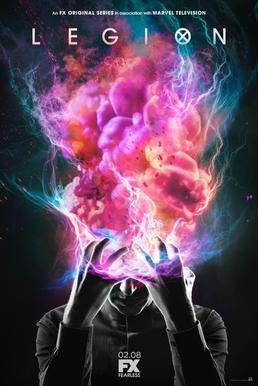
Legion (2016) Season 1
Directed by Noah Hawley, starring Dan Stevens, Rachel Keller, Aubrey Plaza and more

----------This review is spoiler-free but mentions the names of characters and some plot points. Most screencaps are from this excellent tumblr series https://wellntruly.tumblr.com/----------

Ah, comic book adaptations. We've come such a long way since the box-office super-smash, Howard the Duck. It's crazy that we're at the point now where there are new comic book adaptations on streaming services, on a monthly basis with a superhero movie releasing on the regular, multiple times a year. Legion presented by FX came out sometime in the middle, maybe before all of this, and it's only secretly a comic book adaptation. At least, as far as Season 1 goes.
“Please keep talking. So we can all pretend that our problems are all in our heads.” - Sydney
Legion is about a man with paranoid schizophrenia, in his fifth year at a psychiatric hospital named Clockworks, until he meets a girl, Sydney Barrett. She opens a new world to him where he discovers that maybe the voices in his head aren't really a disease -- they're part of his super powers. Season 1 explores this idea in a myriad number of ways, from flashbacks to dream sequences, to musical montages and more.

Legion didn't do all that well commercially, and concluded after three seasons. In my opinion, it was ahead of its time and the world just wasn't ready for it. There are all these jarring, nonlinear cuts that could really turn a viewer off, but in my mind that's not a bug. It's a feature. The mind doesn't work in a linear fashion, at least not always and not all minds. Binging is an ideal format to experience the show, when you can go straight from one episode to the next, but I can imagine that it took the right kind of person who was going to watch it serially, as it came out.

The penultimate episode is this amazing set of  musical sequences, capped by a silent film rendition of the action climax. It's not about the fisticuffs in this series, and sometimes the show will just skip right to the aftermath of an intense action sequence -- such as when we view the aftermath of David's visit to Divison Three. The action isn't just on the screen -- it's in the mind, and it's conveyed so creatively here, whether that's through a dance montage or dream hike up to a floating ice cube.

I've never seen such an eclectic, brave show like Legion. It addresses mental illness and childhood trauma in a unique fashion, that in my opinion feels so right. The mind isn't linear. We jump back and forth between memories all the time at a whim. Legion predates similar Disney+ series like Moon Knight and WandaVision, yet it feels miles ahead of them. And I adore these shows! I can't recommend Legion enough -- I can only guess that, when it did come out maybe I wasn't ready to appreciate it, but now that I have, I'm so freaking glad to have experienced it


-------------Spoilers follow, with/without context. You've been warned-------------
  1. Ep 1: The bollywood dance scene set to French music. This might be in my top 3 this season. I love returning to it, and did you know, the DVD for Season 1 actually has an extended version that they didn't use? What a travesty!
  2. Ep 4: The slow reveal is a fantastic use of the medium -- where we slowly see what Amy's, David's sister, prison cell looks like.

  1. Ep 5: Where Sydney learns what's going on in David's head. He's provisioned out a "mindspace" where they can actually touch ('just electrical signals in your brain'), but even that isn't a safe space from the terror living in David's mind. What's normally a beautiful song turns to horror.
  2. Ep 6: Lenny puts Sydney to sleep. This is lowkey my favorite scene in the season and it took me so long to find it on YouTube. Under the guise of music therapy, Lenny as the psychiatrist of the mind Clockworks hospital suggests listening to some music on her headphones, all the while there's a throbbing, bleeding piece of flesh on the wall. Sydney's hesitant but agrees, cueing a haunting but beautiful musical sequence. She seemingly floats away and gets tucked into David's childhood bedroom, like Lenny is tucking her away into a corner of David's mind, to get her out of the way. It's such a quiet scene with a mountain of style and a confident atmosphere. Certainly my favorite scene.
  3. What a fantastic sequence in Ep 6 led by Aubrey Plaza, as "Lenny," the parasite living in David's mind. Context is everything here -- it's a wordless, musical dance sequence that conveys what Aubrey is doing in his mind, now that David is imprisoned in a small corner of his own mind. Lenny goes through his memories one by one, devoid of David and has her way in each room-memory. Brushstroke wipes appear as she dances, conveying each time in David's past that Lenny was a part of it, all along. This TV show is so good at "showing," not telling, and it's bits like these that make me love it. Scenes without dialogue are just as important, if not more so than scenes with dialogue.
  4. Ep 7 -- The silent film scene. Sydney and Kerry attempt to break David out of his mind-prison, when Lenny attacks them. Honestly there's so much going on here that needs explaining that I'm just going to save it here for myself

Follow chezkevin on rss | twitter

Batman: The Telltale Series

Most screenshots are from Mobygames.com

For 12 year old chezkevin, before there were comic books, there was video games. I've always enjoyed video games, and one of my first console games was Activision's Spider-Man for the Nintendo GameCube, based on the Sam Raimi movie series. I had the whole strategy guide for it, which even included a dope movie-style poster. Besides Super Mario 64, it was one of my first 3-dimensional video game experiences, having mainly had 2D platforming experiences on my GameBoy as a kid. I initially didn't get very far in that game -- I got stuck in the subway tunnels trying to chase down the Shocker. I didn't pick it up again until a few years later to discover that I merely had to web zip in between train lanes to get to him. The game was a breeze after that. Since then, I've played an assortment of games like Spider-Man: Shattered Dimensions, Resident Evil 4, and most recently Metroid Dread.

Winter break gave me some time to get reacquainted with my Nintendo Switch game system. Metroid Dread is a masterpiece and it was so gratifying to see the conclusion of the Metroid storyline, a story over 20 years in the making. I looked for what else my Switch could offer me, and I saw Batman: The Telltale Series on sale for only $5. I'm a sucker for Batman, a sucker for games, and a sucker for deals. A holy trinity!

Batman: The Telltale Series (2016)

Telltale Games, Inc. entered the games industry in 2012, with an episodic adventure game for The Walking Dead. I remember reading rave reviews about this new style of game, beyond just a "point and click" choose-your-own-adventure game focused on storytelling. You had to make difficult choices in the story that had profound consequences later on. I could imagine having to make a choice to save my wife or to save my child from a zombie attack, and shuddered at the thought!

I've played Batman games before. The whole reason I purchased a PS3 in college was so I could play the Arkham series -- a series that truly catapulted superhero games into the modern era of video games. I get a rush out of remembering the epic takedowns I did from the shadows, as well as using detective vision to find clues and gliding through the skyline of Gotham City. That made me feel like Batman in ways I hadn't before, and The Telltale Series does the same thing -- but in a completely different manner.

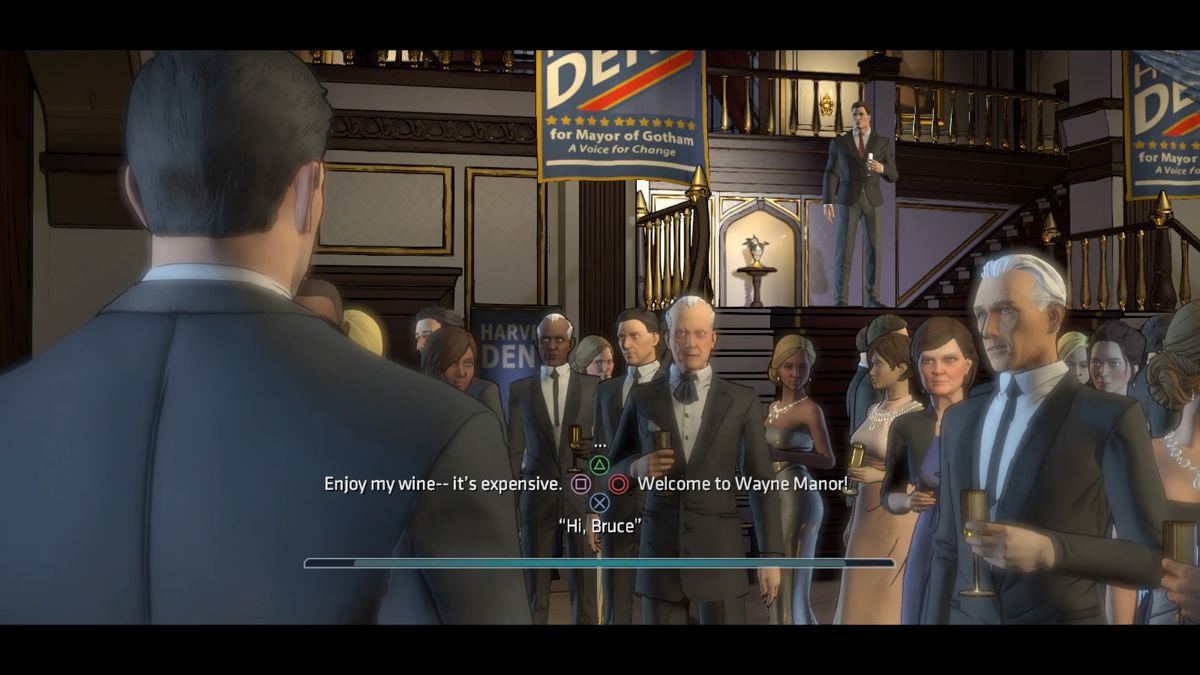
The home screen of Batman: The Telltale Series shifts between a brooding Batman in the nighttime, and a hopeful Bruce Wayne staring at a horizon, amidst some generic dramatic movie-style score. Immediately you see that Bruce Wayne has an equal part in this game, if not moreso than his persona of the Batman. The game throws you in the middle of Gotham's mayoral election, for whom you're funding the fresh face Harvey Dent, amidst the rise of the terrorist organization the Children of Arkham. You and Harvey are close friends in your shared goals of a better Gotham, not a tough stretch to make. The tough stretches start when you realize in episode 2 that Harvey Dent's girlfriend is Selina Kyle!

I was a little incredulous of some of the plot elements, even the first hint in Episode 1 that Bruce Wayne's father, Thomas, might not have been the benevolent philanthropist that we always thought he was. However, as time went on, I saw that these stretches weren't just plot conveniences for contrived drama. These were critical parts of the story that define how you will make the choices that you do. I had to shed off some of my Bat-fan prior knowledge, to accept that even though this world looked familiar to me, with familiar characters, it was still its own universe with its own differences from what I was used to. They're allowed to change the characters in this way. Because of this, Telltale sets itself apart from other Batman games by building a rich story that's all it's own.

In this game, you make choices of all sizes -- whether that's how to greet people at a fundraiser, or whether to save Harvey Dent or Catwoman from a terrorist attack, and they all matter. At the end of every episode, the game gives you a summary of how you did, and compares you in aggregate to other players. I wasn't surprised that I and over 90% of other players chose to romance Selina Kyle in Episode 3. But I was later surprised to discover that, because of a choice that I had made in episode 1, I was able to prevent Harvey Dent from getting disfigured, and fully unleashing his persona "Big Bad Harv," AKA Two-Face. I also began to wonder just what other storylines I could "unlock," depending on my choices. I really felt that my choices mattered, and defined what kind of person I wanted to be. In that way, Telltale made me feel like Batman like never before. I literally did get to choose my own adventure, and I got to choose what kind of Batman/Bruce Wayne I wanted to be. For a $5 experience, I couldn't ask for anything more.

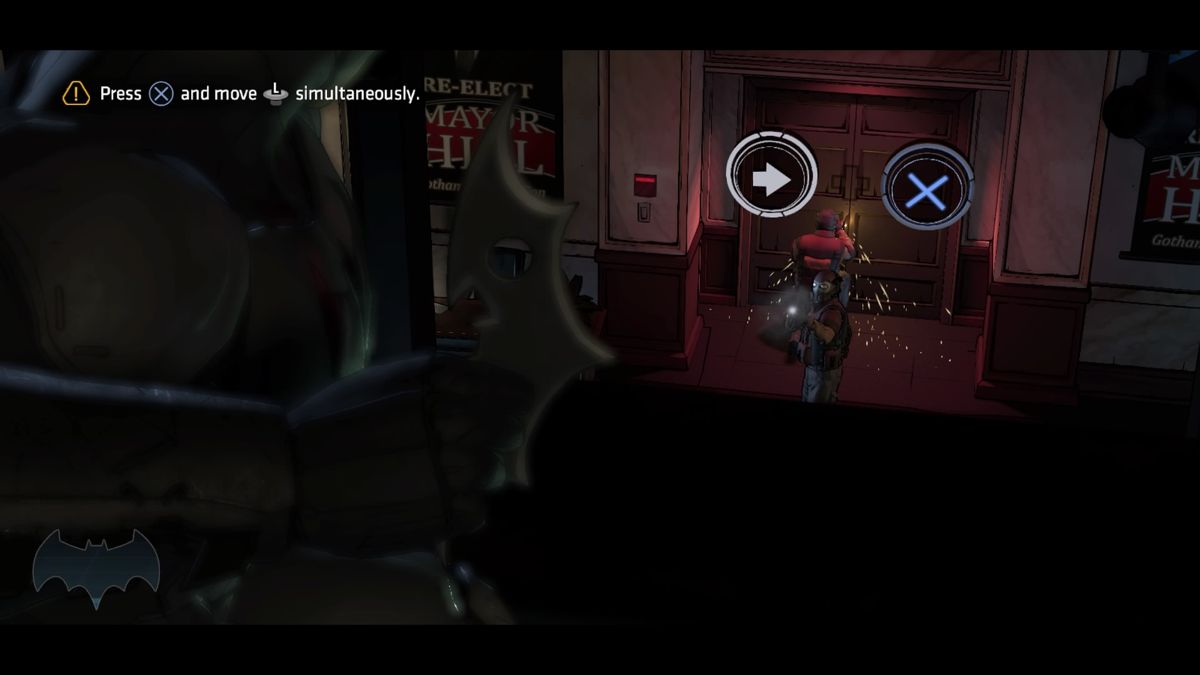
Some comments on the video game-y parts of this adventure: there's really only a handful of different game elements here. As Batman, you need to respond to quick time events to do things like dodge a punch or throw something at an opponent. I wasn't a fan of them, and at least for the most part they're not obtrusive. It does suck to miss a prompt on a part of the screen that you weren't paying attention to, and then Batman dies to a floor trap that you didn't see coming, but checkpoints are generous and you basically start right from where you left off, emphasizing that the gameplay is never about these quicktime events to begin with.

Most of the time QTEs actually kept me from enjoying the action. Rather than watching the satisfying crunch of Batman taking down a bad guy, I was on my toes scanning the screen for whatever next button or direction I had to punch in next.


The other game-y element of this series was the detective portions. These were pretty cool. This is probably the only portion of the game where you can actually explore a 3D environment. It's here that you have to investigate a crime scene, zoom in on a clue, or get information on a bad guy. It's up to you to link together pieces of evidence, or decide how to take down a person. When you do link those together, you get feedback from Bruce/Batman on whether it would work or not. I never felt punished for making a wrong link, and felt like I could really explore and develop a plan of attack or link the right pieces of evidence to find the right insight that would move the story along. I felt like I had agency in the plot.

Finally, a note on the graphics. They have a slick cel-shading effect immersing you into the comic book world of Telltale's Gotham City. The entirety of the scenes are procedurally generated from their game engine, seamlessly tying you into scenes where you have to make choices with scenes where you can just sit back and relax. However, it's also a crutch. A lot of times character models clipped into themselves while moving, breaking the immersion. Emotions are there and do what they need to do, but they're not exactly movie stars.

Random comments/spoilers below. Read at your own risk.
  1. What a twist! It was just heartbreaking to learn that my father, Thomas Wayne was maliciously committing people to Arkham Asylum for personal gain!
  2. I think it's so interesting that the first way I phrased that sentence, is in the first-person. I'm not saying that Bruce Wayne felt betrayed by his father. I'm saying that I was betrayed by the evil deeds of my father. This just goes to show you how immersive an experience this can be, when you are the one having to make the decisions, and choosing the words that you give to the world.
  3. The majority nighttime scenes, and low-stress gameplay make this an easy bedtime play. As a father of two now, bedtime tends to be the only time that I can have to myself. I could easily put my earbuds on, fire up the Switch on the lowest brightness and enter the world of Bruce Wayne. This was a good break after the intensity that is Shovel Knight New Game+
Follow chezkevin on rss | twitter

Batman Volume 6: Graveyard Shift

by Scott Snyder, Greg Capullo, James Tynion IV and more
collects BATMAN #0, BATMAN #18-20, #28, #34 and BATMAN ANNUAL #2

This collection contains a smattering of issues, mainly because they're all standalone stories, exploring from the start of Batman in the Zero Year, to the future of Batman in Batman Eternal. Supporting characters get a little more of the spotlight here, but that isn't to say that Batman doesn't get plenty of time too.

Stories range from the supernatural, as Batman encounters a demonic summoning of the "Will O' the Wisp" in "Ghost Lights," to high sci-fi when Batman stages his own breakout of Arkham Asylum in a demonstration on how to improve their security. The quality is high in every story, and not only does Greg Capullo kill it as usual in the Clayface story, other artists get a chance to shine. Mateo Scalera and Lee Loughbridge stand out to me as the artist and colorist for the "The Meek" story. It's a Hannibal-esque serial killer story with brooding colors and confident, sharp lines. I wouldn't mind reading a monthly from these guys, reminiscent to me of Sean Murphy's art. There's a three-page sequence of no words as he buries his most recent victim, that's just haunting. Especially in a series that usually has a lot of exposition and backstory. The art breathes!

The most "on-continuity" story here is the Clayface story, told in issues 18-20. Clayface's mimicry abilities evolve to the point where he can copy the DNA of his victims, and eventually he copies Bruce Wayne's identity leading to a showdown between Bruce Wayne, and Batman. This is all happening in the context of Damian Wayne's death, AKA Robin and Bruce's biological son. It hits all the right beats, from the high-tech gadgets that keep Batman one step ahead of his foes, to the pensive emotions as Bruce looks through old recordings of his adventures with Damian. Gonna make a grown man cry here, when I just wanted to look at Batman punch people.

Capullo just kills it with Clayface. I could look at this guy's Clayface for days. Just look at the detail.

It's just so satisfying to read a title of consistent quality and with artists of high quality. Every short story does something different here, whether it's a story of hope seen in the first lighting of the Bat-signal, in issue 0, or the brooding mood of the serial killer in "The Meek." It's not one of the mega-storyarcs that we've seen before like with "Death of the Family" or "Dark City," and I wouldn't want this collection to be. This anthology is a brilliant way to collect the standalone stories printed thus far and I can't wait to read more.
 
Follow along for more New 52 Batman:

Batman by Grant Morrison Omnibus: Volume One

Batman AdventuresBatman by Snyder and CapulloJLA...sure, what's another Batman series to start? I have to follow my heart when I read, and there's always room for more Batman. Grant Morrison made his mark during the "British invasion" that matured the comics industry with series like Neil Gaiman's Sandman, and Alan Moore's Watchmen. He revitalized the JLA in the 90's making it the premier DC title, and in 2006 he was given the premier bat-title, Batman. He did a bunch of weird things with the Dark Knight, and it was pretty entertaining. What stood out the most to me was the introduction of Damian Wayne, featured in Batman & Robin with Frank Quitely. Mainly what I wanted to collect was this title, collected in Batman by Grant Morrison Omnibus Volume Two, but I couldn't exactly help myself. I got the full 3-volume set. So today, here's the first volume:

Batman by Grant Morrison Omnibus: Volume One
by Grant Morrison, Adam Kubert, Lee Garbett, Tony Daniel and more

For continuity's sake, here's the stories collected:
  • Batman's year-long hiatus from publication, as seen in the comic book experiment 52, concludes here: Batman returns to Gotham City after exorcising his demons, fears and doubts in a journey to Nanda Parbat, including a month-long sensory deprivation meditation experience.
  • Batman and Son: Bruce Wayne strikes a romance with the head of an African nation and global humanitarian, Jezebel Jet. He discovers that he has a son, grown in a laboratory and trained as an assassin by Talia Al Ghul, from the Dennis O'Neil classic, Birth of the Demon. Damian Wayne is a brash, cutthroat kid who's convinced that he's going to help Batman in his war against crime. Damian makes for the perfect foil that helps us see Bruce Wayne in a fatherly, compassionate light. Both Damian and Talia seemingly die in the climax of this story, after failing to hold hostage the Prime Minister's wife.
  • Three Ghosts of Batman: For some reason, various police officers are impersonating Batman, and he gets a taste of the second one here: the Batman that accepted shots of Venom and is a weird amalgam of Bane and Batman. He handles it, but for some reason, he knows there's going to be a third one, thinking of his Black Casebook, a collection of dreams, hallucinations, or adventures that he couldn't explain. The third Batman: the one who sold his soul to the devil and destroyed Gotham City.

  • Resurrection of R'as Al Ghul: Batman tied in to this 8-part crossover story with the other bat-titles, but there's way too many gaps in the story that reading the two Batman issues doesn't do it any justice. 1-page synopses inclusions from Chris Burnham are neat, but left me empty without being able to read the story in full.
  • The Black Glove: Meet the Man-of-Bats and his sidekick, Little Raven! Knight and Squire of England! All these Batman-inspired heroes and more meet at the Island of Mister Mayhew, for their annual Club of Heroes meeting. But it turns sinister when they realize that someone is killing them one-by-one. It's the ultimate theater of Good vs. Evil, engineered by the mad psychiatrist Simon Hurt.
  • Batman R.I.P.: An explosive shell to the chest, the kidnapping of his girlfriend, all open him up to psychic suggestions laid by Simon Hurt. He finally triggers them, and drives the Batman to madness -- except Batman has a backup plan for even this! Enter: The Batman of Zur-En-Arrh, the Joker's return from being shot in the face by a Batman look-alike in the first issue, and Dr. Hurt's final drama of Good vs. Evil.
  • One-shots: There's various one-shots here, including a kooky prose-style issue that foreshadows the "punchline" in Batman R.I.P. Issue #666 imagines a grim future where Damian is Batman and fights the Batman of Hell. The omnibus ends in a two-part story that explain what's going on in Batman's head, as he attempts to break free from the psychic prison of the New Gods attempting to build a clone army from him, before he's seemingly murdered by Darkseid's Omega Beams in the finale of Final Crisis. The two-part issue does a great job explaining what makes Bruce Wayne Batman, and why he can be the only person that can be Batman.
All things considered, the stories told make for one super-arc that begins with the first issue collected and ends neatly in the third-to-last issue, before the Final Crisis tie-in. The theme goes beyond the typical crime noir that you'd expect from modern Batman stories, and pays tribute to the adventures he's had in the past, while paving stories for the international set in the future. The author isn't afraid to dip into the supernatural and makes the title a jack of all trades, expanding the way we view the Batman. The man who's thought of everything, including even what he hasn't thought of!

It's a shame that the art couldn't be consistent. Adam Kubert's lines are dynamic and action-oriented, perfect for the James Bond-style story that kicks it off. But fill-in artists like Lee Garbett and later the main artist Tony Daniel put in their perfunctory superhero art. Standard, with nothing exciting, and sometimes it's the script that has to do the heavy lifting. Like, what's going on in this page? Reading the art only confuses you; you'd have to read the words to tell what's going on.


I suppose I only have myself to blame, but I purchased this edition in "Acceptable" condition on eBay and it came with the binding torn off. It feels like I'm murdering the book every time I open it, but it's stayed intact so far and doesn't affect the reading experience. It's an unfortunate way to keep these stories, but given the inconsistencies in the art itself, it was worth saving the extra $15. The cover art of the book itself is this neat double-bat icon, and I loved looking at it in my week-ish-long binge of the book. Page numbers are marked but inconsistently since the art often bleeds into the margins.


Follow chezkevin on rss | twitter

The Batman Adventures Volume 1

The Batman Adventures was a continuity-free, all-ages(-ish) comic meant to follow up on the success of Bruce Timm's Batman: The Animated Series of the early 90's, itself a follow-up to the success of Tim Burton's Batman movies of the late 80's. They even used the same theme song!


What a time to be a kid. 8-year-old chezkevin caught the fever around the end of the series, but that was basically my first exposure to Batman. I loved it. I drew Batman on the walls around our house. My grandpa got me Batman shoes, and used the shoebox as his personal spice rack. I imagine opening the cupboard and it warms my heart to see that shoebox in there, a reminder of both my childhood heroes. My uncle got me the 1998 Batman & Mr. Freeze: Subzero animated movie on VHS for Christmas that year...from Blockbuster. Remember those?!?

For these reasons, Batman: The Animated Series will always be close to my heart. I'm a sucker for nostalgia. The way that Batman looks in this particular design will always be home to me. So it's a no-brainer that I picked up the 4-volume collection of the comic book spin-off. For whatever reason, these 10-issue collections are budget-friendly at $2.99 or $3.99 at comiXology. They're worth much more than that.

The Batman Adventures: Volume 1
by Kelley Puckett, Ty Templeton and more
Collects the first 10 issues of the 1992 series
  • Issue #'s 1-3: The Joker orchestrates heists for two villains -- The Penguin in #1, and Catwoman in #2, and reveals himself in issue 3 to kidnap Jim Gordon, Harvey Dent, and murder them on live television. All-ages, huh?? Issue #1 is unique in the wry humor depicted as the Penguin attempts to infiltrate high society and educate his henchmen, makes this one unique.
  • 4-5: Scarecrow hits the scene with a "dyslexia ray" that causes car accidents and riots in Gotham City. It's up to Batman and Robin to stop him. This story is a great example of how some of Batman's villains are victims...of themselves. Jonathan Crane, while imprisoned in Arkham Asylum, accepts an offer to teach part-time at a college to reduce his sentence. When he despairs at the students he's given, there's only one person left to turn to...
See the tears in his eyes. You can tell that he really doesn't want to give in, but he can't help it. This psychotic persona is the only way he can cope. Like a lot of other Batman villains, he's a victim of himself.
  • 6: One-shot murder mystery...and Bruce Wayne is suspect #1! Batman and Robin work together to deduce a murderer, all while Bruce is in jail. The main highlight from this issue is the atmosphere. It all takes place one dark and stormy night. With the shadows given by the charcoal drawings, it really feels like you're watching an episode of the animated series.

I love this scene. Really evokes the pulp origins of Batman. What an amazing piece of sequential art.
  • 7: Killer Croc one-shot. Batman tracks down a Chicago mobster and his path crosses with Killer Croc, who's fighting in an underground boxing league. It's much more a Croc story, who is about to face an old foe that he once lost to before. It's here that the art shifts to Mike Parobeck, who can still evoke the style of the animated series, but oftentimes there's shortcuts that make the characters look like they're Playskool action figures. Not a fan.
  • 8: Clayface one-shot -- Clayface pulls off an elaborate string of heists, and plans to retire in a life of anonymity -- but not before Batman stops him. Another pensive slice-of-life style story like issue 7. 
  • 9: Batman goes to painstaking lengths to acquire a red book, evidence of crime boss Rupert Thorne's misdoings. After a standoff at Thorne's mansion, he survives and does get the red book to the prosecution...making Thorne sweat for 15 minutes before the jury, bought with Thorne money, acquits him. You can't win them all, but sometimes, even 15 minutes is a win.
  • 10: The Riddler, discontent that the Batman always solves his riddles, makes one last ploy to steal the same set of jewels as Mr. Nice and the Perfessor. Batman catches him anyways, but only because he knew the jewels were a hot item, failing to solve his initial riddle. The Riddler, even though he's caught once again, is triumphant in having stumped the dark knight. The writers are able to take this limitation of the series -- that it has to maintain the status quo -- and turn it around and make these stories into musings about the villains really shows the strength of the characters.
The art takes a dip when it transitions to Parobeck, but for the most part he's still serviceable. It's so difficult in comics to have both quality and reliability, consistently, but the sequential art remains strong with him. You can never go wrong with triple batarang action:

Follow chezkevin on rss | twitter

Joker: Death of the Family

Collects Detective Comics 16-17, Catwoman 13-14, Batgirl 14-16, Red Hood and the Outlaws 15-16, Teen Titans 15, Nightwing 15-16, Batman and Robin 15-17, Batman 17. Also collects the portions of the following issues: Suicide Squad 14-15, Batgirl 13, Red Hood and the Outlaws 13-14, Teen Titans 14, 16, Nightwing 14 and Batman 13
Wifey and I finished James Gunn's The Suicide Squad last week, on Sunday between our children napping. It's kind of remarkable how Harley Quinn has overtaken the Joker in the public mind. Joker's last movie was in 2019, and Harley's not only been in Birds of Prey in 2020, but now The Suicide Squad in 2021. For a supporting character of a supporting character who was created in the animated series, she's certainly done well for herself.

Today we turn our attention to her less-popular, criminally-insane former lover: the Joker. For roughly a year, Joker had his face surgically removed in Detective Comics (2011) #1, and then disappeared off the face of the Earth. Around 2013, he came back with a renewed sense of purpose: to revive his relationship with the Batman by killing off his family tree and support network. In his eyes, the Batman had grown weak by building a family of superheroes in Gotham City, and who better to remedy that than the person who's known him the longest...the Joker?

The "main" story is in the Batman title, from the start of the Joker's crime spree to the end. This Joker-centric collection is more in an anthology style with the Joker parading around Gotham City to harass the various different people that Batman's networked with. Here's the cliffnotes for the various stories:
  • Detective Comics 16-17: The return of the Joker inspires all the crazies that were already there in Gotham. One such group is called "The League of Smiles," a group of Joker fanatics performing murders in his honor. Batman has to figure out who the "Merrymaker" is, orchestrating their actions and stop them from murdering more innocent people. It's a clever, tightly-done 2-issue mystery that you see coming from a mile away, but still a great vignette on just how much the Joker has warped the people of Gotham City.

  • Catwoman 13-14: Way too quickly-paced, with the Joker placing Catwoman in an absurd amount of death traps. They needlessly shoehorn Catwoman into the story, adding some baggage from a previous issue that's going to confuse any new readers. The only purpose of these issues is to contrast Catwoman's independence from the Batman, against Joker's fixation on the Bat, all delivered in the final page of the story.
  • Suicide Squad 14-15 (portions): Harley has her reunion with Joker and, a reckoning. In the year that had gone by, despite their love for each other, they're just not what the other needs anymore. The Joker still thinks he can convert Harley to his way of thinking by...subjecting her to death traps, but Harley's not the person she used to be. Worst of all, he purposely exposed the hyenas they raised together to rabies, and she has to kill her babies. Of course, Harley lives to fight another day and the Joker moves on with his plans, but definitely an important storyline to check on.
  • Batgirl 14-16: The Joker kidnaps Barbara Gordon, Barb(Batgirl)'s mom. Apparently it had been years since she last saw her mother, who fled Gotham City to protect her from her psychopathic younger brother James Jr. Ensue the death trap, and ensue the insane plotline: the Joker proposes to Batgirl, and even more insane: Barb accepts. This story could have been Barb's chance to find closure for the events of The Killing Joke, and some scenes skirt around that but never see it fully ripen. The story cuts a little short in my opinion to serve the main story, when the Joker defeats her and takes her to his lair, but otherwise a decent read.
  • The Batfamily titles all end on the same cliffhanger -- with Joker about to unveil a hidden dinner plate, presumably their faces cut off. I've already read Death of the Family several times over, but I can't even remember what was in the dinner plate! It made for a suspenseful read throughout the trade. The Red Hood and the Outlaws team up with the Teen Titans to save Gotham City from a Joker poison outbreak, all a distraction to lure Red Robin and Red Hood to Joker's lair. The Joker somehow knows everyone's secret identity and uses Dick Grayson's personal relationships to defeat Nightwing in the circus and end up in Joker's lair. Of particular highlight is Batman & Robin 15. Bruce keeps Damian, the current Robin, in the Batcave to keep an eye on things, but Damian can't help but venture out and try to help find Alfred. It leads him to the Gotham Zoo, an obvious trap, where the Joker orchestrates a dramatic fight between Damian and someone who looks an awful lot like Batman. The coloring is fantastic and the Joker's never been more terrifying than here. I'm just a sucker for shadows. Check out this two-page scene as Robin enters the zoo.

  • The storytelling is great in this issue. It's easy to get caught up and only want to read the "main" line of Batman comics, but this issue is a great example of just what exactly you miss out on, if you do only that.
  • Eventually Batman confronts the Joker in Batman 17, in which the Joker sets up another death trap, imploring the Batman to choose between his family, and his true family of the villains that he won't ever kill. You can guess how it ends.
  • The story ends with Batman & Robin 16/17, another vignette-style look at Gotham Manor, after a harrowing night. We get a peek at the dreams of Alfred, Damian, and Bruce, and it's interesting being a part of those dreams and seeing how it informs their feelings.

Reading this tome is a lot like eating potato chips. When you're hungry, you can't really think so you just grab the whole family size bag of potato chips. The first 15 minutes are great, because you're finally getting rid of that hungry feeling. But around the middle, your stomach is starting to hurt. You've already gotten this far, and it still tastes pretty good, so now you're eating just to keep that taste in your mouth. By the time you finish, well, now you have cramps and your stomach is full...with regret.

OK that last part isn't so true for the collection. It's still a solid Batman story, but the middle of the collection just gets very repetitive. You're thrust in the middle of the books of supporting characters, who have their own supporting characters you're supposed to care about, but they've already had a years' worth of comics to build those relationships and the emotional stakes. Any reader coming into those books cold just aren't going to feel the emotional impact of the Joker killing/jokerizing/imperiling them like a reader who's been following them the whole time. But I will admit, there is the occasional gem in the collection, the kind of gem that's so good, well, you have to read the rest of the series. Batman & Robin shines as the best example, though I bet there are some other decent ones out there too, like Suicide Squad, Batgirl, and Detective Comics. The best comic is the kind of comic that gets you to read more comics, and this collection throws so many stories at you that a few of them are bound to stick.

More New 52 Batman:

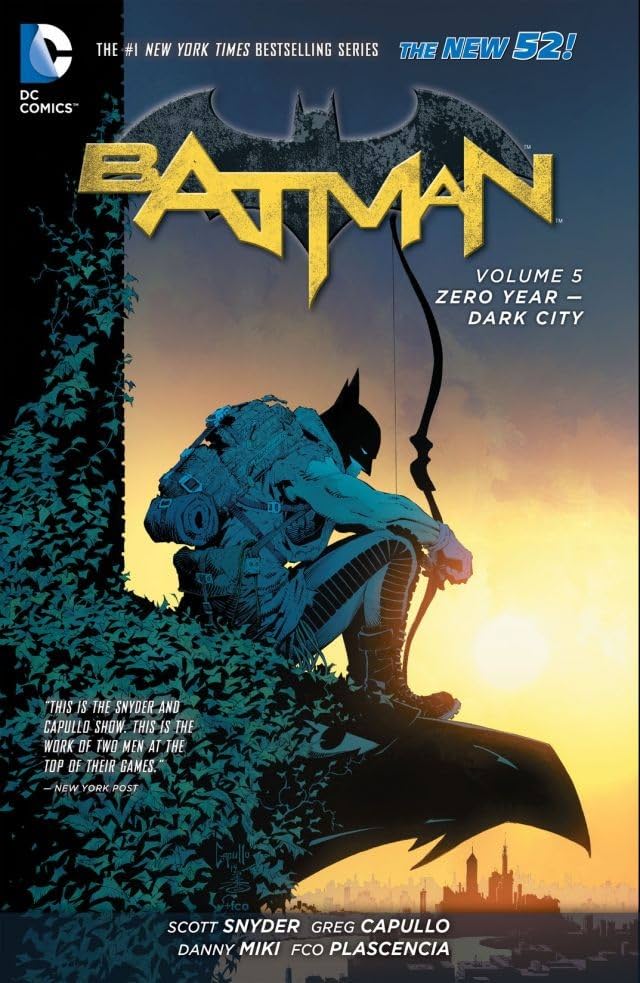
Batman Vol. 5: Zero Year -- Dark City

Collects Batman (2011) #'s 25-27, 29-33
by Scott Snyder and Greg Capullo

Batman's adventures continue in his so-called "zeroth" year of existence in Gotham City. This collection includes two storyarcs, the "Dark City" storyline which dovetails into "Savage City." Dark City introduces Dr. Death to the New 52-niverse, a mad scientist responsible for a bone growth serum meant to repair physical trauma. It's titled "Dark City" because of the Riddler's takeover of the electrical grid and subsequent blackout. Savage City sees the fallout from Dark City after a superstorm, in which the Riddler completes his takeover of Gotham City and isolates it from the rest of the world. There's a lot to unpack in the 8 issues, but that's the bare bones of it. Add in some prevalent flashbacks of Bruce Wayne as a child, and Bruce Wayne as a teenager, and there you have "Zero Year -- Dark City."

It's kind of outrageous how far they go in so few issues. The Riddler has an army of drones, a secret base that's jamming communication with the outside world, and even a pit of lions to dump his foes in. I know it's no less absurd than established narratives like Arkham City or No Man's Land but talk about scope creep -- the Riddler's done more in Batman's zeroth year than the Joker did in Volume 3, supposedly year six of the Batman's career! I know I complain that some storyarcs take too many issues to tell, but I think a huge storyline like Savage City would have benefited from more than 4 issues. To me, it was a Planet Hulk style story, and that story took 13 issues to tell.

Both stories are wrapped within the theme of "zero." It's here that you learn that the two featured villains are foils to Batman. There's a long exposition-y action scene where Dr. Death explains what the moon meant to him and his son, who tragically died on an army mission in the desert. Previously he pretended that the moon would watch over them both, but when his son was killed, he adopted a nihilistic view. The moon in the sky is empty, and the thought that it offered protection was an empty promise, giving Dr. Death a tragic origin. In his mind, you have to seize your own means of protecting yourself. This is at odds with what Bruce Wayne as Batman eventually learns over the course of the two stories. He gains allies in both Alfred and Lieutenant Gordon, knowing that he can't do what he wants for Gotham, alone.

What zero means for the Riddler is that, now that he's culled the weak from Gotham City after the superstorm, they all live in a shared year zero from which they can start the future and model a superior existence for the rest of the world, by....answering riddles. It's a little far-fetched, but if you've ever wanted to see the Riddler get his own terrorist city, look no further. 

Compare this to what zero means for Bruce Wayne. He was the man who came back to Gotham City, despite all of the things that's happened to it, and happened to him. Through "Secret City" he learned that he couldn't do it in secret. He needed to be both Batman and Bruce Wayne. Through "Dark City" he learned he couldn't do it alone. He needed to work together with his friends and the city's professionals. And through "Savage City" he put them all together. There's such an on-the-nose climax scene when Batman has to turn the power back on to the city, in order to prevent it from being bombed by the Federal Air Force. The Riddler has a battery pack hooked to his chest that signals the city's power grid. Bruce has to literally attach the battery to his chest and pump 1000V into it, bonding his heart with that of the city's, signaling that the city no longer belongs to the Riddler. He's literally given his heart to the city: it's the bat's now.

BONUS highlight: around the climax of Dark City, Batman has to take a leap of faith to make a 70-foot jump to the Riddler's blimp, when his grappling hook fires only up to 50 feet. He jumps, and the winds of the storm do the rest for him in an epic homage to Frank Miller's Dark Knight Returns.

One more Miller homage: this time, explaining Alfred's motivations and his new understanding of the man that Bruce Wayne has become.

Volume 5 explores Batman's earliest year in a new way, re-introducing the allies we know he's come to gain, and giving a new take on a couple of his supervillains. It uses homage to legitimize the New 52-niverse and succeeds. I consider the first story stronger than the second but they both have their merits and are worthy additions to the New 52-niverse.

Related Posts Plugin for WordPress, Blogger...

Stats a-go-go